Nature of Divine Justice

This story is about a man who was seeking to understand the nature of Divine Justice. The man’s elder sent him to observe life from a hidden place and here is what He saw.

First, he saw a rich man stop along the road where there was a spring for a rest. He watched him take out his purse and count 100 gold coins. But, when he got back on his horse he absentmindedly left his purse lying there. Later, another man comes along and finds the purse and immediately takes off with it. Next, a poor man comes and sits down in the same spot to eat some bread. About this time the rich returns to retrieve his lost purse. He finds the poor man there who knows nothing about the purse. Thinking the poor man was lying, the rich man beats him thinking he stole the purse. He beat him so badly that he died. But when he examines his pockets he does not find the purse.
The man sent to observe life turned to the Lord in prayer saying: “Lord, what is the meaning of this Will of yours? Please explain how Your Benevolence can tolerate such injustice?” A angel of the Lord then answered him as follows: “Of all the things you just witnessed, some were by God’s concession, others were for education, and others had providential reasons. He who lost the coins was the neighbor of the one who found them. The latter had an orchard worth 100 gold coins. Being greedy, the rich man forced him to sell it for only 50 coins. The disadvantaged man turned to God in prayer and asked for God to take care of this injustice. Therefore his discovery of the purse with the 100 gold coins was God’s providence which had responded to his prayer to give him his money back two fold.”
“The poor man who was murdered unjustly also committed murder once in his life. He had repented and afterwards lived a God pleasing life. He constantly asked God to forgive him for the murder and to give him a death just like the one he had inflicted.” “Naturally, the Lord forgave him based on his repentance. God was moved by his sincerity and his efforts to live a life according to His commandments and his desire to pay for his crime. Thus the Lord granted him his wish and allowed him to die a violent death and then took him into His bosom.
Finally, the greedy man who lost all his gold coins and then committed the murder would have a disastrous end due to his greed and love of money. God therefore allowed him to fall into the sin of murder so that his soul would be severely pained and he would seek to repent. The result was that this person did repent and abandoned all worldly pleasures and become a monk. “Now in which of these cases did you find God to be unjust or cruel or insensitive?”

Saint Paisios

Posted in Love and Mercy | Tagged , , , , , | Leave a comment

To cover or expose our nakedness

adam

The feeling of spiritual nakedness is the most critical moment in our lives, because at this point one of two things will happen: either we will get up and get dressed or we’ll remain naked.  In other words, we’ll either present ourselves to God in our nakedness and say, “We have sinned,” or We’ll try to hide from God, like Adam and Eve.  When God calls us, Where are you?, We will say: Hiding, because we are naked.  And when we emerge from our hiding place, He’ll see our fig leaves.  Today, in a practical way, we’ll conceal ourselves and took shelter in the ideas and temporary pleasures of this world.  But the problem is God will call us out.  Our conscience is a small god and we will not be free until we expose ourselves.

Why do we often choose to conceal ourselves and cover things up?  For the simple reason that it is a terrible thing for us to realize that we are nothing.  Do we know what it means to go from thinking that we’re special and important, from being respected publicly, from thinking that we have done great things, from being talented, wonderful, good-looking, charming, to recognizing on the contrary, we’re naked and of no consequence whatsoever?  It requires strength to accept that, a lot of strength.  And yet we can’t even accept the slightest blemish that we might have, or any fault, failure, error or sin that we may have committed, without covering it up with a lie, and then covering up that lie with a second one, and then the second with a third.

A person may conceal his or her nakedness by means of an inferiority complex, by acts of aggression, by self-justification, by donning various masks, and by many other means.  Instead of exposing our nakedness, we seek to regain our balance and compensate for the weakness that are exposed by standing on what we believe are good qualities, such as our beauty.  Our “beauty” may be physical, emotional, intellectual, or even “spiritual”.  But it makes no difference.  Whatever it is, it is a substitute for our nakedness.

Such strategies of denial also involve concealment from ourselves.  What does that mean?  It means that, even though we’re naked, we’ll live as though we were not, and thus live a double life.  Joseph’s brothers told a lie about his death and just started to live a normal life. But it is nothing but normal for they could not banish the thought from their conscience.  Or we may refuse to grow and progress, as though we were not naked at all.  And this is something much more terrible, for it is a rejection of reality, and such a rejection can only have tragic consequences for us.  Life is full of people like that. They know they’re sinners, they know they’re naked, and yet they go through life doing the very things which they hate, which disgust them, which they know are beneath them.  And they know that they must somehow silence the terrible cry of their conscience, which torments them (Roman 7:15-20).

Our other alternative is to accept our situation and say: we’ll do something about our nakedness.  We will declare our sin.  We will confess our sin and our nakedness.  And naked though we are, we will nevertheless present ourselves to God.  We’ll tell Him: “You clothe us.”  And that takes great strength.  To turn to God as if nothing else in the world exists requires tremendous honesty and authenticity.  And what are the means by which we will either accept our nakedness or pursue a life of concealment?  That, which we call the ego, the self.  Until we surrender it to Christ, we will continue to live in temporary reliefs and eternal torments.

Posted in Humility | Tagged , , , , , , | Leave a comment

What is the Church?

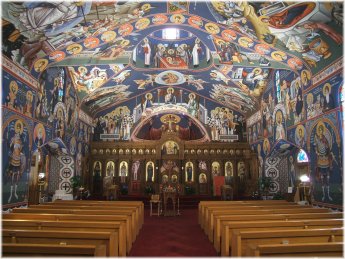
frescoes

The Orthodox Church is the true Church of God on earth and maintains the fullness of Christ’s truth in continuity with the Church of the apostles.  This awesome claim does not necessarily mean that Orthodox Christians have achieved perfection; for we have many personal shortcomings.  Nor does it necessarily mean that the other Christian churches do not serve God’s purposes positively; for it is not up to us to judge others but to live and proclaim the fullness of the truth.

But it does mean that if a person carefully examines the history of Christianity he or she will soon discover that the Orthodox Church alone is in complete sacramental, doctrinal and canonical continuity with the ancient undivided [New Testament] Church.

Fr. Theodore Stylianopoulos


Posted in Faith | Tagged , , , , , | Leave a comment

Saint Mary-Mother of us all

Saint Mary

The memory of the Church is maternal because the Church itself is our mother.  Each of us, have been reborn in the womb of the baptismal font.  The deepest point of the church is identity.  The one woman who defines the church is the one whose icon always stands at the front of the Church, whose icon is always prominent when the church gathers, the lady who kept all things pondering in her heart.

When the word was made flesh and when the memory of the church was established, it was through the conscious and willing assent of Saint Mary’s faith.  The Gospel of Luke begins with angelic messages and ends with angelic messages.  In each case the angelic messages is given to a male and female.  The angel begins with giving a message to Zachariah, father of Saint John the Baptist.  Zachariah does not believe him.  Zachariah was struck dumb because if we don’t have faith, we are supposed to keep our mouth shut.

At the end of the Gospel, the angel appears to our Lady, the Mother of God.  She believes.  The deepest memory of the Church is the memory of the Virgin Mary.  She is the Mother, at the heart of the Church.  She is however very silent for she does not say much and has very few recorded words besides the Magnificat.  Saint Mary represents the silent contemplation of the Church.  She is the one who literally embodies Christ.  She en-fleshes Christ.  Since she did that, there is not much to say. Is there?  The men can talk about it but she is the one who did it.  That is why she becomes the very heart of the church.  That is why the Orthodox Church focuses on Saint Mary for we need to be like her that Christ may be born in us today.  Her life, well lived, becomes an intercession for the Church until the second coming of Christ.

When the Holy Spirit descended on the Church in the upper room, the Apostles were the ones who went out and spoke.  The Holy Spirit did not descend simply on the Apostles.  Saint Luke mentions that the holy women were there with Mary the Mother of the Lord.

May the prayers and intercession of our most beloved lady Virgin Mary, the Mother of God, be with us all.  Amen.

Posted in Faith | Tagged , , , , , , | Leave a comment

Counting ourselves as nothing

luke 17-10

Bear in mind the Lord’s words; when you shall have done all those things which are commanded you, say, we are unprofitable servants, we have done that which was our duty to do. (Luke 17:10)  This leads us to the humility of counting ourselves as nothing, which is a suitable material for His refashioning.

This is where the God of Christians creates from.  It is proper for our God to create from nothing.  When we reproach ourselves for the misery of our fall and embark on a downward journey, the proud spirit of the enemy is unable to follow us.  Thus, we are freed from his power.  The enemy cannot go down.  By self-reproach and journey downwards, we confess the universal truth that all have sinned and come short of the glory of God.  Then we attract the Spirit of Truth.  The practice of self-reproach leads us to having an ever increasing number of humble thoughts which have an effect of kindling in us the grace of repentance, thus, increasing our inspiration for salvation.

Sourcehttp://patristicnectar.org/bookstore_160329_1.html Prophetic Life and Authenticity in the Church, Archimandrite Zacharias (Zacharou)

Posted in Confession | Tagged , , , , | Leave a comment

Preparation for Divine Liturgy is the key to receive full benefit


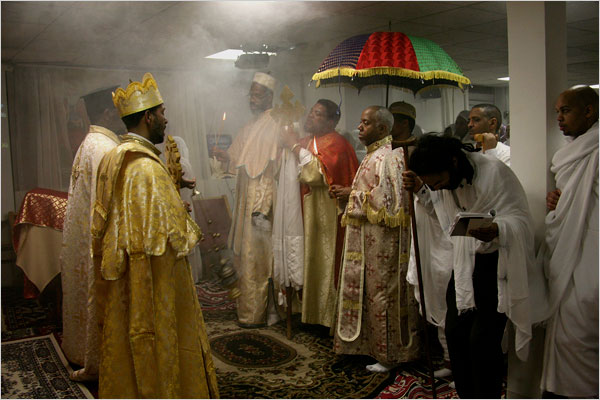
ethiopian liturgy1

We need to absolutely prepare for the services.  We should have some time of prayer before we attend the Divine Liturgy.  And then when we go to the service, we are in harmony with the service and we are not distracted.  But if we go without preparation, the service will suffer because of us and we shall suffer as well.  We need some preparation and not jump from the bed to the service.  If we don’t prepare, we will dry up.

If we prepare before the services, we have a certain blessing of the preparation, a certain peace and certain warmth.  And on that, we shall add the blessings of the service.  We need to bring something, in order to receive full benefit of the service.

Each one of us has a particular gift, says Saint Paul.  And we should have a gift in order to be members of the body of Christ.  We need a certain gift in order to be attached and united to the body of Christ.  All the members of the body of Christ are people who bear a gift of the Holy Spirit.  That is why the Lord came to earth to perfect the body because He knew that no individual can contain the worth of His grace and all the gifts of His Spirit.  And He came to earth to perfect the body so that all the members of His body together can embrace or contain all the gifts of His Spirit.  But no individual no matter how great he is whether he is Saint Maximos or Saint Basil the Great can contain all the gifts of the Holy Spirit.

But it is not necessary that we have all the gifts of the Holy Spirit.  It is only necessary to have one small gift to attach us to the body of Christ.  And that will make us partakers of the gifts of all the other members of the body because of the unity of the body for there is only one head, our Lord Jesus Christ Himself.

How do we get this little gift which will be the key of opening to us the communion of the gifts of all the other members?  Above all, it is the gift of repentance.  If we come to the assembly of the other members of the body with the dispositions we have gained in our repentance before God that becomes the gift which will unite us to the body. It will make us rich in the sharing of gifts of the other members of the body.  Not only the visible members in that assembly but of the triumphant members of this body in heaven, all the saints and all the elect of God in every place of His dominion for the Church is one body.

That is why it is so important to have this basic gift, the spirit of repentance, for everybody.  We should pray to God continually to give us the spirit of repentance because this spirit of repentance is like a circle of fire around the person which does not allow him to fall into sin.  To some extent, the spirit of repentance contains all the gifts of the Holy Spirit for it is a general gift.  It is very necessary.  It is indispensable.  The Gospel begins with the preaching of repentance because it is the door to enter the Church.  It is also the perfection of the gifts of the spirit because the Gospel finishes with the preaching of repentance.  Above all, we need the spirit of repentance in order to have an introduction to the body of Christ to be partakers of the gifts of all the members of the body of the communion of grace which is the nature of the Church.

When we come to Church, we have to bring a gift to the assembly.  These gifts are not visible; it is not only in bread, wine and water.  We must bring spiritual dispositions such as humility, the fervor of our repentance and the dispositions that we have labored to acquire in personal repentance.  And these dispositions create in us a mystical space in the heart where our spirit moves freely.  When we come to the assembly, we don’t have to make big prostrations or manifestations of piety.  We stand there like being indifferent.   But there is a space in us where our spirit freely makes its presentation before God.

We need the preparation before coming to the assembly of the body of Christ for many reasons.  In order to have this space in us, which will enable us to present ourselves to God without any external manifestation and also which will make us partakers of the gifts of the other members of the assembly.  But if we come without gifts, a gift in our case,  the powerful dispositions of the heart that we have acquired of personal repentance, we don’t do justice neither to ourselves nor to the other members of the body of Christ.   

Posted in Divine Liturgy | Tagged , , , , , , | Leave a comment

Healing neuroses — suggestions and warnings

In this chapter, we will try to go into more depth about the ways to heal nervousness, discuss the spiritual approach to this problem, speak of psychotherapy, familiarize the reader with several methods of psychological self-help, offer recommendations of a healthy nature.

Spiritual clinic.

The only true path to recovery from neuroses lies through the Orthodox faith, repentance and improving one’s life to live by God’s laws. The most important thing for a person to understand is the sinful sources of his illness, to thoroughly realize his weakness, to hate the sin of pride, conceit, anger, melancholy, falsehood, adultery, greed and gain; to want to change himself, with honest repentance turn to the Lord.

It is absolutely necessary for the ailing to attend services, take part in the Mysteries of the Church — Repentance (confession) and Communion. The following words are in the prayer, which the priest reads before confession: “Take heed, therefore, lest having come to the physician, you depart unhealed.” One must partake of the mysteries often and with a grieving heart, deep faith and hope in God’s mercy.

It is essential that one read the Holy Scriptures, especially the Gospel, and fulfill the laws of Christ which are contained in it. “There is not a single illness out of all the illnesses that burden human nature, neither spiritual nor physical, which could not receive doctoring from the Scriptures” (St. John Chrysostom).

The literature of the holy fathers and lives of the saints offer invaluable help, where they provide models for imitation, revealing the true destiny of man, the greatness of moral beauty, patience and steadfastness when faced with difficulties.

Spiritual life is impossible without fast and prayer. “Howbeit this kind goeth not out but by prayer and fasting”(Matt. 17:21). With the blessing of a spiritual father, it is good to memorize separate psalms and prayers. The role of prayer in attaining and keeping inner peace is very great. Elder Sampson (Seavers) asserted, that the peace of the soul in one who prays constantly is protected from external disturbances.

The soul is strengthened by pilgrimages to holy places, Orthodox monasteries. is Commemorations in the Godly Liturgy and molebens offer great help; regular consumption of Epiphany-blessed Holy Water with prosphora, piece of artos; sprinkling the residence, the sick person himself, and his personal property with holy water.

It is essential to keep track of the processes which are occurring in the soul. One must keep track of one’s thoughts, because every bad act is usually preceded by a bad thought. One must definitively cut off anything negative, sinful, vile, not enter into any sinful discussions. The Orthodox Church teaches how to battle sin in its very beginning, on the level of thought.

“The process of the transformation of sin from thought into action has been determined precisely by the Holy Fathers. The entire course of action is as follows: at first there is the introduction (i.e. a sinful thought arises from nowhere), later attention (“conversation” with the sinful thought — and this is already the beginning of accepting the sin), later (sinful) pleasure, afterwards the desire (to actuate the sin), then decisiveness, and, finally, the act (see Philophei of Sinai, Philokalia, v. 3, Ch. 34 and so on). The longer a person permits temptation to entrench itself in the soul, the closer he is to downfall.

‘Introduction’ is the simple presentation of an object, either from the act of feeling, or memory and imagination, presented to our consciousness. There is no sin here, since the birth of these images is not in our power. Sometimes, though, it can become a fault, if the tempting image is regarded with the mind and the person enters into what might be called a conversation with it.

Sometimes the object attracts attention to itself by its novelty, astonishment, but afterwards, when its impurity is realized, it must be banished, otherwise it becomes ‘attention’. He who has banished a sinful thought, has extinguished the internal war. ‘Pleasure’ from sinful objects is already a sin. It is only a step from pleasure to ‘desire’. ‘Decisiveness’ comes from desire. The desiring person has stated his permission to act, but has not yet thought up or done anything to attaining his goal; the decided has already considered everything and decided; the only thing left is to ‘act’.

Therefore one must avoid all possible “ideas,” fantasies, fruitless imagination, particularly of a sensual nature.

One must learn not to judge others. If someone is being denounced or judged in your presence, you should lead the conversation elsewhere, and if that is not possible — leave.

One must always blame oneself for everything that happens in life, then the soul will achieve equilibrium, spiritual peace and quiet. “If everyone would blame themselves, the result would be peace,” wrote Archbishop Arseniy (Zhadanovsky), — self-reproach lets us bear offenses quietly, not feel them.”

It is healthy to break the habit of verbosity and arguing over trifles. One must certainly deny everything false, ostentatious, theatrical, pretense, exaggeration, hypocrisy — everything that is everything sinful, even little things.

http://www.orthodoxphotos.com/readings/psychotherapy/suggestions.shtml

Posted in Confession | Tagged , , , , , | Leave a comment

Godliness for healing

The healing of ‘spirit’ may be exemplified by St. Gregory of Nyssa, who said that curing
the spirit is acquired by Godliness by those who gaze upon the Cross of Jesus, as the
Israelites gazed on the staff of Moses: “There is one antidote for the evil passions
[spiritual illnesses] : the purification of our souls which takes place through
the mystery of godliness.

The chief act of faith in the “mystery of godliness” is to look to Him who suffered the passion for us. The person who looks to the One lifted up on the wood [the Cross] rejects passion, diluting the poison with the fear of the commandment as with a medicine.

The voice of the Lord teaches clearly that the serpent lifted up in the desert is a symbol of the mystery of the cross when he says: “The Son of Man must be lifted up as Moses lifted up the serpent in the desert”. (St. Gregory of Nyssa in Malherbe & Ferguson, 1978). This healing takes place by being fully united to the Church, in prayer and sacraments.

Posted in Confession, Humility | Tagged , , | Leave a comment

Elder Aimilianos of Simonopetras-On Prayer

Excerpts on Prayer from The Authentic Seal: Spiritual Instruction and Discourses By Elder Aimilianos of Simonopetras, Mt. Athos.
On Prayer (pp. 197-205)
When we talk about internal prayer of the heart, we do not say petition of the heart, but “prayer”. When we speak of petition, however, we mean that our prayer is directed towards a particular person, its aim being union with that person. While prayer is static..[an] enjoyment of a place where God also is. There is a distinction you see. Petition, is turning to a person. It follows that…the active presence of this Person must exist for me. I have to be able to become familiar with His presence and His existence. Christ, the indwelling [One] Who is everywhere present, becomes present for me in my life through my participation in worship, and more particularly, through my participation in Holy Communion.

It follows that worship and Holy Communion are indissolubly united. And what do they do? They make God present and alive for me…and what then remains? For me to speak to Him, to address Him Who comes to me. and so He, through worship, tends towards me and I…tend towards Him, until our total union occurs…I cannot say that I will go to church if I have not been praying.

It is superfluous for me to go to church and unnecessary for me to attend the Liturgy and useless for me to take Holy Communion if I am not continuously at prayer. And it is superfluous for me to pray if I have no part in what we have just been speaking about…You know how to plant a flower: you dig the earth there, you put in manure..so that the root will take. If you don’t put in that fertilizer, if the soil is not suitable…it’s a waste of time planting the root.

Prayer is sterile and does not go higher than our heads — how much less does it reach beyond the clouds and up into the heavens – if it does not have its mystical realm..which is in particular, vigil, study and fasting. …Do you know what it means for flesh to enter the realm of the spirit? Flesh, [carnality] which does not inherit the Kingdom of Heaven, to enter into God? Do you know what it means for God, Whom nothing can contain, to find room in my soul?. ..So when I pray, I feel at once this insurmountable obstacle blocking me off from God: the fact that I am flesh, that is I am a carnal creature [in the sense of the Gospel meaning here], the fact that I am flesh and He is Spirit…

With God’s holiness and brightness I immediately comprehend my weakness. I feel that I can do nothing and that I am starting a dreadful struggle, a battle, as the Old Testament so beautifully presents it to us with that battle, that..wrestling match of Jacob’s at his famous ladder. Here must I, a puny human being, break through into Heaven and besiege God and..it follows that we experience prayer when we start ..as a struggle. ..

Not a struggle in the sense that I want to go, for instance and eat and I say: “No I shall continue to pray”. I do not mean that struggle. That is the ascetic struggle and..different altogether. I am speaking of the struggle we have, not with ourselves – but the struggle we have with God. I wrestle with God..When Paul said “contend with me in prayer”, he meant something like that. ..He was saying “You struggle with God, too with your prayers, so that our struggles may be united and in this way..we can wrestle with Him..[Just as Jacob did] and defeat Him”… When you have an opponent, you tense up immediately. Your punch gets stronger at once. You see your muscles …and realize you’re hitting and being hit. When I do not have the sense of this struggle with God, as you will realize, I have not even begun to pray…..What matters is that there should issue forth [from the heart] a cry from the depths, which like a powerful bomb, like an earthquake, should shake the Heavens and make God answer, in the end, and [respond to us]… .God wants us to sense Him first [and the struggle to reach Him] with the powerful distress of the cry from the depths of our beings which we raise to Him….

Excerpts from The Authentic Seal: Spiritual Instruction and Discourses
Posted in Prayer | Tagged | Leave a comment

The Faith of the Mind and the Faith of the Heart

Faith inner.jpg

Human beings can have two kinds of faith.  The first kind of faith, which has its seat in the mind, is the reasonable faith of acceptance.  In this case, a person rationally accepts something and believes in what he has accepted, but this faith does not justify him.  When Holy Scripture says, man is saved by faith alone (Ephesians 2:8), it does not mean that he is saved merely by the faith of acceptance.  There is, however, another kind of faith, the faith of the heart.  It is referred to in this way because this kind of faith is not found in the human reason or intellect, but in the region of the heart.  This faith of the heart is a gift of God that you will not receive unless God decides to grant it.  It is also called ‘inner faith,’ which is the kind of faith that the father of the young lunatic in the Gospel asked Christ to give him when he said, “Lord, help my unbelief.” (Mark 9: 24)  Naturally, the father already believed with his reason, but he did not have that deep inner faith that is a gift of God.

Inner faith is rooted in an [empirical] experience of grace.  And since it is an experience of grace, what would this make inner faith as far as an Orthodox Christian is concerned?  Inner faith is a noetic prayer.  When someone has noetic prayer in his heart, which means the prayer of the Holy Spirit in his heart, then he has inner faith.  Through this kind of faith and by means of prayer, he beholds things that are invisible.  When someone has this kind of vision, it is called theoria.  Theoria, in fact, means vision.

As a rule, there are two ways for vision to take place.  When a person has not yet attained to theosis, it is still possible for him to see by means of the prayer what the Holy Spirit is saying within his heart.  After attaining to theosis, however, he can see by means of theosis, in which both this inner faith (prayer of the heart) and hope are set aside, and only love for God remains (as a gift of God).  This is what St. Paul means when he says, “But when that which is perfect is come, then that which is in part shall be done away.” (1 Corinthians 13:10 and 13:13 Since faith and hope have fulfilled their purpose and man has reached the point of seeing God, the source of this faith and hope, he now simply knows (becomes) and loves the One who is love.)  When the perfect is come, faith and hope are done away, and only love remains.  And this love is theosis.  In theosis, knowledge come and end; prophecy is set aside; tongues, which are noetic prayer, cease; and only love remains.  St. Paul says this in the passages of great clarity and beauty.  The Church Fathers in turn offer interpretations of these subjects that are indisputably correct.

By Protopresbyter Fr. John Romanides

Source:  http://www.johnsanidopoulos.com/2015/04/the-faith-of-mind-and-faith-of-heart.html

Posted in Faith | Tagged , , , , | Leave a comment