Their God is my God

There is nothing new in being told that we are dust and shall return to dust. We hear it every year. Ezekiel pondered that when he saw a valley of dry bones. The answer came when God breathed, and the bones came alive again, “an exceedingly great army” (Ezekiel 37:10).

Man cannot be in harmony with God’s plan, or “justified,” by his own good behavior without the breath, or “grace,” of God which comes through Our Lord Jesus Christ. This is why Christ said that no one is good except God (Mark 10:18). But there is still the free will of man.

Dry bones and limp lives can come alive by giving God permission to make us what he wants us to be. While no one is good except God, each of us can become perfect (Matthew 5:48). This is not a contradiction. Goodness is a quality of being; perfection is the result of contact with that goodness. Perfectionism is a neurosis based on the confusion of goodness and perfection. The secular progressivist dreams of building an ideal society on earth through human effort, and learns the hard way that utopias end up being hells.

Perfection is achieved, not when there is nothing more to add, but when there is nothing more to take away. Perfectionism tries to add, as though goodness were a sum, while perfection subtracts that which obscures goodness.

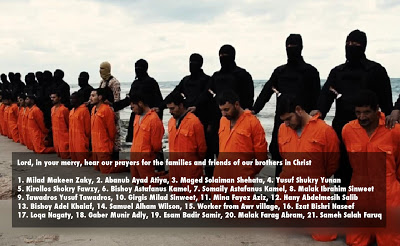
Exactly two years ago this month, (Feb 2017) twenty young Coptic Christian Egyptians were kidnapped by Islamic State militants while on a work crew in Libya. They refused to renounce Christ and chanted in chorus. . .

coptic

“Ya Rabbi Yassou!”—

“Oh my Lord Jesus!” 

A black youth from Chad, Mathew Ayairga, not a Christian, was watching and, when asked by the captors, “Do you reject Christ?” he replied, “Their God is my God.” He was baptized by blood when all twenty-one were beheaded. While these martyrs had never heard of the theological disputes over grace and justification, they were confident that Christ can raise life eternal from dust and ash.

Posted in Faith | Tagged , , , , | 2 Comments

Joy in the Fellowship of God

psalm 63

Brief interpretation of Psalm 63

Psalm 63New King James Version (NKJV)

Joy in the Fellowship of God

A Psalm of David when he was in the wilderness of Judah.

63 O God, You are my God;
Early will I seek You;
My soul thirsts for You;
My flesh longs for You
In a dry and thirsty land
Where there is no water.
So I have looked for You in the sanctuary,
To see Your power and Your glory.

Because Your lovingkindness is better than life,
My lips shall praise You.
Thus I will bless You while I live;
I will lift up my hands in Your name.
My soul shall be satisfied as with marrow and fatness,
And my mouth shall praise You with joyful lips.

When I remember You on my bed,
I meditate on You in the night watches.
Because You have been my help,
Therefore in the shadow of Your wings I will rejoice.
My soul follows close behind You;
Your right hand upholds me.

But those who seek my life, to destroy it,
Shall go into the lower parts of the earth.
10 They shall fall by the sword;
They shall be a portion for jackals.

11 But the king shall rejoice in God;
Everyone who swears by Him shall glory;
But the mouth of those who speak lies shall be stopped.


Here you have a brief interpretation of Psalm 63. The psalm’s primary message is communion with God, which is to be valued more than life itself (v. 3). Do we see God? Do we long for God?  How does one draw near to the mystery of God?  By means of the following steps and stages that are described in the psalm.

The first is nocturnal prayer and the ardent search for God, which we saw in the first verse. When I realize that, without God, I am truly a barren desert; when I feel my inner desolation and the suffering of my flesh, then I will seek God «in the night». We cannot say that we have a spiritual life if we do not rise at night to pray.

The second stage, which appears in the second verse, involves the separation of the heart and the mind from all that is within us and around us. For us there exists only one center of gravity, only one point on the horizon; one object alone is within our view, and this is God. Yet how many thoughts are crowded together in our minds and hearts! Upon how many objects do our eyes fasten! Perhaps we’re afraid that our life will become narrow and suffocating if our focus is restricted to one thing alone, and so we rush around desperately looking for something to satisfy us. We desire many things. We accumulate things compulsively; we spend our life collecting and hoarding things, as if we were the proprietors of a cheap junk shop. When I see people whose hearts and minds are distracted by worldly things – and I see this within myself as well – I think: small-time proprietors!  We have become like petty, small-time proprietors! We waste our time gathering second-hand, discarded objects; we amass things with absolutely no value whatsoever. And so I will renounce everything, become a stranger to all things in heaven and on earth, for what have I in heaven? And besides You, O God, what have I desired upon the earth? (Ps 73:25). In order for my heart to be pure, it must be completely liberated from all earthly attachments, and then I shall know what Christ means when he says, Blessed are the pure in heart, for they shall see God (Mt 5:8).

The third stage emerges from the fourth verse. To the extent that we separate ourselves from the world – so that God becomes the focus of our life and the meaning of our existence – all our strength and all our energies will be placed in His service.

The fourth stage, described in the sixth verse, is particularly important, involving, as it does, the ceaseless recollection of God and all His benefits. I remembered You on my bed. If we do not continually remember God, even upon our beds, there can be no union with Him. I remembered God and was gladdened (Ps 77:3). And let us also call to mind the words: Do this in remembrance of me (Luke 22:19), which the Lord said when he established the Mystical Supper, the mystery of the Holy Eucharist, which is both a memorial of, and communion with, Christ. Remembrance is thus a form of union, and there can be no union without remembrance. It is therefore essential to remember God, to hold God within memory, for memory fuels desire, and it is by means of desire that God becomes our possession. And thus we become «Words» of God, just as the Word of God became man. The memory of God should be constant, perpetual, ceaseless.

The fifth stage flows from the seventh verse. In light of the comments we made above, we understand how necessary it is for us to have experiences of God’s grace and His presence.

The sixth stage, which is the grace of God, appears in the eighth verse. We must realize the following truth: in order to begin to live a spiritual life, I must be vividly conscious of the fact that I am nothing, that I can do nothing, and that I am completely incapable and unworthy.  It is only the right hand of the Most High, only God’s grace and power that can produce fruit in my spiritual life. Here we think of the words of Saint Symeon the New Theologian: «It is only when I lament and despair that He shows Himself and He looks at me, He who contemplates all creatures».34 When I have accepted the fact that I can do nothing, when all seems lost, then God visits me, and it is then that I see Him. And what is the result? Life becomes a vision, a delight, and a fulfillment.  In the words of the Divine Liturgy of Saint Basil: «We have been filled with Your life that knows no end. We have feasted gladly on your inexhaustible nourishment».  We are filled with life eternal.  We feast on the food of heaven.  But this food is not available to people who think that they are something, or that they can accomplish things without God.  God cannot commune with people who think like that.  Why?  Because communion with God is contemplation, a vision of God, given to us by God himself.

God is the one who gives us joy, and we should ascribe all our joy to Him.  The soul that thirsts for God, is continually bathed in divine light. The face of such a person becomes divinely luminous. You see him and you ask yourself, could this man be Christ? Thus the Christian becomes a strange spectacle: a Christ-bearer, a God-bearer, and a Spirit-bearer. He or she reveals the unsurpassable beauty of Christ. For our «desire for God transcends our desire for the world, and thus it cannot be satisfied by anything in the world».

My desire is for Christ; my longing is for Christ. It is for Him that my life is being transformed. My path is one of constantly seeking after the Lord.  «And I strain my eyes to catch a glimpse of the One I desire, but He is invisible, and evades my sight».  But eventually He rewards my efforts, and, as Saint Symeon says, «I am amazed at the beauty of His form… From every direction He shines upon me the light of His immortal splendor.

Posted in Faith | Tagged , , , , | Leave a comment

Proof of righteousness is in a peaceful Spirit

12037-p

Proof of our righteousness in God is a peaceful spirit, which the Holy Spirit generates in the righteous soul.  If you do not have this peace, which means that you have no righteousness.  You are governed by fleeting impressions, and do not explore into the depths of God’s judgments, Holy Scripture, and the whole history of the Church which witnesses to them.  I will not try to soothe you with persuasion, nor examples, nor with my own experience, because you do not have the main source of peace in your soul: a firm and undoubting faith in God’s Providence, and in the fact that the head and rudder of the Church is Christ Himself. You have nothing but doubt about everything.

What is Providence? It is one of the basic characteristics of God – to see all that is going on, was going on, and will be going on in the future as though it is the present, and to have omnipotent concern for safeguarding all creation and wisely managing all its manifestations. St. John Damascene describes it thus: “Providence is Divine will which maintains everything and wisely rules over everything.”   If we examine any kind of events and manifestations without looking into their causes and consequences, then many things may seem random to us. If, however, we look at them from a true point of view, i.e. if we judge the things happening in the world from the viewpoint of Divine intelligence, then we will see that there is nothing in the world that occurs randomly, that occurs without the will and the Providence of God. God’s mind is infinite and encompasses everything that we can fathom. The Almighty God penetrates and sees all places in a single moment: the height of the heavens, and the width of the earth, the depth of the sea and the unfathomable abyss.

Could it be that the Lord makes mistakes, or perhaps He does not govern the world at all?  Could it be that those who blew the winds of “freedom” into the Church are the only ones who truly care for it?

The daily Gospels and Epistles answer your questions, and I begin to wonder: could it be that you do not read the Scriptures?  Could it be that all the powers of your soul, mind and heart are spent entirely on contemporary periodicals?

Everything that is going on in the world is not a revelation.  All must come to pass, and the Second Coming is approaching, while people will be saving their souls up until the world’s last days, according to the promise.  Some will be saved, others will perish.  Their main saving activity will be: preserving the faith.  Our soul and heart should be anxious over our own faith, and the faith of those who are entrusted to our care. The lines, Thy faith hath saved thee, go in peace (Luke 7:50), and According to your faith be it unto you (Matt. 9:29), sound throughout all time.

Without faith there can be no peace.  Everyone saves himself in his own field.  Human mistakes — yours, mine, the synod members’, the Patriarch’s — are all before God’s judgment.  But God’s judgment and man’s judgment are not the same.  How often it happens that what seems to the inflamed mind to be a mistake is shown in God’s good time to be a holy work, and the laborer is crowned with a wreath.

So judge for yourselves!  By God’s will both saints and sinners depart from the field of battle — those who built and those who destroyed.  Could you or I pronounce judgment upon how they lived?  No, and again, no!  But I know one thing for sure: I will have to answer for myself. Mainly I will have to answer whether or not I am doing what I am blessed to do, whether I am saving myself like a true slave of my Lord, and whether those who have been entrusted to me are being saved around me.

Posted in Divine Providence, Obedience | Tagged , , , , , | Leave a comment

EXHORTATIONS TO PRAYER, HUMILITY

quote-pray-without-ceasing

And pray without ceasing in behalf of other men. For there is in them hope of repentance that they may attain to God, that they be instructed by your works, if in no other way.  Be ye meek in response to their wrath, humble in opposition to their boasting: to their blasphemies return your prayers; in contrast to their error, be ye steadfast in the faith; and for their cruelty, manifest your gentleness.  While we take care not to imitate their conduct, let us be found their brethren in all true kindness; and let us seek to be followers of the Lord (who ever more unjustly treated, more destitute, more condemned?), that so no plant of the devil may be found in you, but ye may remain in all holiness and sobriety in Jesus Christ, both with respect to the flesh and spirit.

And pray ye without ceasing in behalf of other men; for there is hope of the repentance, that they may attain to God. For “cannot he that falls arise again, and he that goes astray return ? Permit them, then, to be instructed by you.  Be ye therefore the ministers of God, and the mouth of Christ.  For thus says the Lord, “If ye take forth the precious from the vile, ye shall be as my mouth.”  Be ye humble in response to their wrath; oppose to their blasphemies your earnest prayers; while they go astray, stand ye steadfast in the faith. Conquer ye their harsh temper by gentleness, their passion by meekness.  For “blessed are the meek ;” and Moses was meek above all men; and David was exceeding meek.  Wherefore Paul exhorts as follows: “The servant of the Lord must not strive, but be gentle towards all men, apt to teach, patient, in meekness instructing those that oppose themselves.”  Do not seek to avert  ourselves on those that injure you, for says[the Scripture], If I have returned evil to those who returned evil to me.”  Let us make them brethren by our kindness.  For say ye to those that hate you, Ye are our brethren, that the name of the Lord may be glorified.  And let us imitate the Lord, “who, when He was reviled, reviled not again ;” when He was crucified, He answered not; “when He suffered, He threatened not ;” but prayed for His enemies, “Father, forgive them; they know not what they do.”  If anyone, the more he is injured, displays the more patience, blessed is he. If anyone is defrauded, if anyone is despised, for the name of the Lord, he truly is the servant of Christ.  Take heed that no plant of the devil be found among you, for such a plant is bitter and salt. “Watch ye, and be ye sober,” in Christ Jesus.

Posted in Humility | Tagged , , , , | Leave a comment

Flight from reality

reality

If truth is solely simply the product of the human brain, then subjectivity is the only reality.  Each person’s life is isolated.  We have even abandoned the slightest chance of what traditionally is known as friendship and communion.  The only reality is the Me.  The person who says beauty is in the eye of the beholder must logically go on to say that truth is in the brain of the knower.  If the eye creates beauty, then the brain creates truth.  This story illustrates how this plays out.

The American historian Barbara Tuchman in her book The Proud Tower describes an incident in which the painter, Phillip Ernst, father of Max Ernst, was painting a picture of his garden when he omitted a tree which spoiled the composition.  Then overcome with remorse that he violated reality, determined to set the picture right, went out and cut down the tree.  We don’t know to laugh or cry at this story.

This story sends as a parable to everything wrong with western culture today.  This is not an environmental statement.  We cut out, we reduce, and we annihilate whatever is not confirmed to our picture of reality.  We will change reality because it does not confirm to what is going on in our heads.  This is becoming very common.

The thief and the robber who the fathers of the Church say is the devil, who struck the man heading from Jerusalem to Jericho still robs us.  He robs us of reality itself.  Worse than that, this thief has persuaded us that he has not robbed us.  He has left the world in which we live stripped, naked and half dead.  So all of us here who live in this world, is incumbent upon us to love God with the whole mind, to think through the faith, to meditate in the Gospel and to take seriously the challenge of the Gospel, because what is in us is a pearl of great price, the capacity for knowing God.  Amen.

 Taken from All Saints homilies by Father Patrick Henry Reardon

Posted in Uncategorized | Tagged , , , , , , , | Leave a comment

Why technology is hurting our communication skills

techonolgy

It is not that we are bad but when we substitute face book for face time, we don’t see the expression on people’s faces.  We don’t feel the handshake.  We lose that human contact and it becomes separated by our own technology.  And then we feel the separation emotionally.  Then communication becomes more difficult and it makes it harder to maintain relationships.  When communication becomes too simplified and too emotionally distant, then the relationship becomes weakened and attenuated.   It becomes harder to keep, easier to discard, easier to forget and just have a new group of people to connect with electronically that we can disconnect with later on.

In the future, mankind will have difficulty finding the means to have love connections.  There will be more attendance to think what we want and to see people the way we want them to be rather than the way they really are.

Part of a relationship is enduring a conflict of one with the other because every personality is different.  If we don’t conflict with someone, chances are we won’t connect with someone.  Conflict isn’t necessarily bad if it leads to understanding.  But if we even refuse to be with someone, we will never know that friction can actually rub the edges smooth and the two can become one.  When we don’t even have the opportunity to disagree, we make idols of people.

Posted in Service | Tagged , , , , | Leave a comment

Love saves

Posted in Videos | Tagged , , , , , , , | Leave a comment

Why We Should Blame Ourselves

abba-dorotheos

Saint Dorotheos gives us a most difficult teaching. He says,

“The root cause of every disturbance, if we examine it carefully, is from not blaming ourselves…. Whatever happens to us, whether it be damage, or dishonor or any other affliction, we deem ourselves worthy of it and are never troubled.”

We logically respond, “if someone upsets me and I have have not done anything to justify this, how and why should I think of myself being worthy of this?”  Saint Dorotheos answers this by saying that if we search ourselves more deeply with “fear of God” we will find that there was a word, a gesture, a facial expression or a deed that triggered the seemingly unjust action in the other person. Then, if we think further still not seeing any error, we can search into the past and think about how we might have offended this person at some earlier time causing their attitude that caused them to act in a way that upset us at this time. Even digging more deeply, maybe they suffer from some other sin or had a recent encounter that upset them and is being reflected in their current action against us. Therefore, our reaction was not called for we should have been more sympathetic to their distress. Saint Dorotheos says, “Therefore, as I said, if a person searches himself in the fear of God and diligently examines his own conscience, he will certainly find that he is guilty.”

The very fact that another person upsets us indicates that we have hidden in our sub-consciousness a passion that is triggered by another person’s action. When someone does something that upsets us it gives us cause to dig deep into our inner being to discover why we react in this way.  We know all our brothers and sisters are sinners like ourselves. Why would their action be cause to turn us to anger or being upset? If we have love for our neighbor as we are called to by Scripture, we would have compassion for the plight of our brethren.  We would not act in a way that would cause them further difficulty, but instead, try to act in a way that would lead them to overcome their sinfulness. Our caring thoughts would then be directed towards them rather than ourselves.

I think this teaching gets at the core of the meaning of “love your enemy”.  When our soul is strong and our heart pure, we can withstand any affront by another person without being upset. We become able to maintain our inner calm no matter how we are attacked. Besides, what good does it do to get upset?  What is achieved in worldly terms other than create distress and turmoil? We lose our inner peace and most likely separate ourselves from God, and are now unable to respond in a godly loving manner.

Let’s challenge ourselves to reflect on this teaching. Think about your inner peace and how important it is to retain it and how easy it is to lose it. How often we fail to think in loving terms about the condition of our neighbor. We know we are better servants of our Lord when we maintain this inner peace. Try using those instances where we are upset by others to learn something about our own sinfulness and how we can improve ourselves. This is all part of the way of repentance that brings us closer to God.

Reference: Abba Dorotheos: Practical teaching on the Christain Life, pp 143-150

Posted in Confession, Love and Mercy | Tagged , , , , , , , | Leave a comment

A movie about forgiveness

Posted in Videos | Leave a comment

Why is my life miserable? Why do I live a mediocre life?

the-wisdom-of-god

It is fitting that I ask this fundamental question, for I will discover the true meaning of life in its answer. The simple answer is I don’t have wisdom.  In 2 Chronicles 1:7 God appeared to Solomon, and said to him, “Ask! What shall I give you?”  Notice that the first step in finding my life is to ask.

Matthew 7:7 “Ask, and it will be given to you; seek, and you will find; knock, and it will be opened to you.  Solomon responded saying 2 Chronicles 1:10  Now give me wisdom and knowledge, that I may go out and come in before this people; for who can judge this great people of Yours?  And God gave Solomon wisdom and understanding beyond measure, and breadth of mind like the sand on the seashore, so that Solomon’s wisdom surpassed the wisdom of all the people of the east and all the wisdom of Egypt.  If I have this wisdom, I can’t possibly live a mediocre life.  That has been proven by the life of Solomon.

Then, What is wisdom? Or who is Wisdom?

If we look into sacred scriptures, we shall discover the name of Wisdom is mystically ascribed to Jesus Christ.  And thus Solomon cries to the Father: Give me the Wisdom that sits by Your throne (Wisdom of Solomon 9:4).  And who sits next to God, at the right hand of the Father, exalted above all created things, if not the Lord Jesus Christ?  For He is indeed, the Power and the Wisdom of God (1 Corinthians 1:24).  Elsewhere Solomon says: I determined to take Wisdom to live with me, knowing that She would be a counselor for me (Wisdom of Solomon 8:9).  The very essence of Christ is Wisdom.

Wisdom, then is clearly a Person, and not simply an attribute.  It is the Son of God, who is also God’s Word; His Wise Word, as the Fathers say.  Seeking Him, longing for Him and abiding in Him is the key in answering the above question.

Matthew 6:33 But seek first the kingdom of God and His righteousness, and all these things shall be added to you.  This is the Kingdom where Jesus Christ is King.  Is He my King or someone else?  If He is, then He has come alive in my heart and guides me step by step in my life as long as I am willing and asking.  I will find meaning in all the issues of life only in Jesus Christ and countless Saints throughout the ages have proven this reality.

Prayer 

O Lord, God who is all in all to me, Life of my life and Spirit of my spirit, have mercy on me and fill me with Your Holy Spirit and with love that there may be no room for anything else in my heart. I do not ask for any blessing, but for Yourself, You who are the giver of all blessings and of all life. I do not ask for the world and its pomp and glory, or for heaven, but I need You Yourself, for where You are, there is heaven. In Yourself alone is satisfaction and abundance for my heart; You Yourself, O Creator, have created this heart for Yourself, and not for any other created thing. Therefore this heart cannot find rest in nothing but You: only in You, O Father, You who have made this longing for peace. So now take out of this heart whatever is opposed to You and abide and rule in it Yourself. Amen.

Posted in Faith | Tagged , , , , , , | Leave a comment